Beyond The Code
It's About Time to Become More Human
With Umer Ghumman · 4 min read
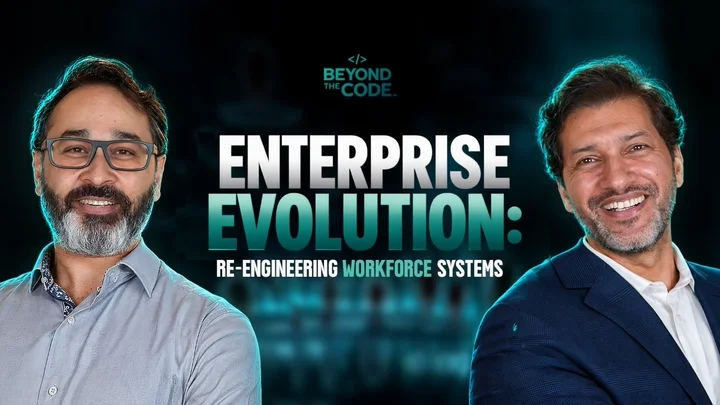
A conversation with Umer Ghumman, Executive coach, NLP practitioner, about leading Gen Z and what we should do with the time progress has given us.
I sat down with Umer Ghumman, Executive coach, NLP practitioner, and former Country Head of Samsung in Pakistan and Afghanistan, for the fifth episode of Beyond The Code, expecting a conversation about how leaders should work with a younger generation. We did get to that. What he kept returning to was the time we now have, and becoming more human.
How leaders should talk to Gen Z
I asked him the practical question. Most of the leadership in the room is Gen X or millennial, and in some cases the generation before that. How do you give those leaders a way of talking to Gen Z?
His starting point was that this generation arrives with a different mindset. Their reference point is not ours. The work we used to do in three months, he said, they can now do in a couple of hours, so a 9-to-5 slot bores them. They want to be mentored, on their terms, by leaders who speak their language.
He talked about them with a lot of sympathy. When he goes into companies, he is often talking to millennial bosses and Gen Y chief executives about new inductees who do not fit the box those leaders still have in mind. I think he meant Gen X and older there, since millennials and Gen Y are the same generation. You cannot, he said, take a cookie-cutter approach to the environment you build. Every generation, he said, has been in some conflict with the one after it. My read is that what has changed is the speed.
Time to become more human
He put it this way.
“We were humans 125 years back. Then we were becoming human-like, human-ish, humanoids. Now, it’s about time for us to become more human.”
The reason he gave, immediately after, is that we now have more time to invest in ourselves, and to stay connected with the people around us. He set that against an older picture of evenings spent with friends, and against younger people who would rather be able to move, work and live in the present than inherit the old markers of having arrived.
Meaning is whatever you make of it
Later he talked about the method he uses in his coaching. There are presuppositions, and there is reframing: taking a negative thought and turning it into a positive one. “Meaning of anything is whatever you make out of it.” He used a lucky-charm ring as a small example of how we condition ourselves, then closed the thought simply: this is what NLP practitioners do.
Are we going back towards humanity?
I had been listening for a human-first stance, and I said so. I also put the other view to him. Yuval Noah Harari’s Homo Deus describes a move from Homo sapiens to a hybrid of technology and human. A lot of people believe that, I said, and to some extent I do as well. So are we going back towards humanity, or is the future a new species?
He did not reject the longer evolutionary story. Farming, industrialisation, information technology: machines took over work that used to belong to us. His latest observation, he said, is that the point of the time we have saved is more time to connect with the people we love, our families, and what comes next.
Paying a bill used to mean joining a queue. Sending money used to mean a money order at the post office. He remembered waiting on a draft for his MBA fees when his father worked in Saudi Arabia. Now the same things happen on a phone, almost instantly. “We have a lot more time than waiting, we have a lot more time than getting frustrated. So we have a lot more time for our family, our health, connectivity.”
“I think we have more opportunity to be even better human.”
I did add one caution, almost as an aside. This picture is easier for people who can already afford the technology that saves the time. There is another class still struggling, who may only get that time later. I parked it as off-topic and came back to the conversation.
There is hope at the end of it
I told him his perspective was refreshing. Coming from the technology side, it is easy to talk as if we are heading towards a terminator era. Listening to him, I could see hope at the end of it.
Thanks to Umer Ghumman for the conversation. Watch the full episode on YouTube.