Beyond The Code
Nobody Wants a Process. Everyone Wants a Button.
With Yury Shishkin ·
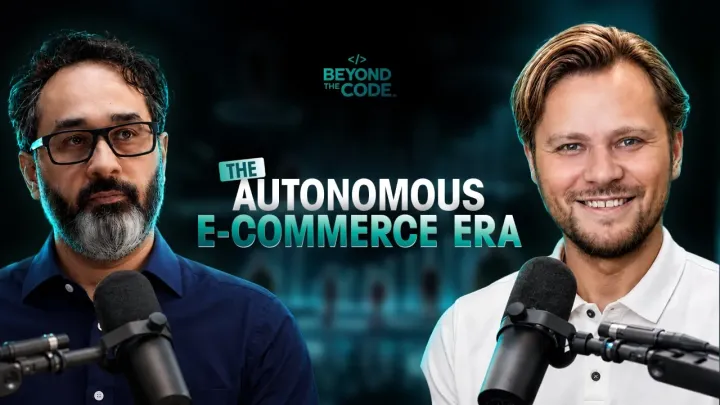
A conversation with Yury Shishkin, founder of 24 Online and IDRF, on the line between automation and AI, the data every e-commerce brand ignores, and how close the industry is to running itself.
I sat down with Yury Shishkin for the first episode of Beyond The Code expecting a tour of AI products. Eighteen years in e-commerce, the last four building AI-based solutions for brands in the UAE, plus a community of a few hundred people in the region called IDRF. I went in to talk about tools. I came out with a clearer line between what AI actually replaces in a business and what people only wish it would.
The myth of the one-button fix
Every AI company hears the same request eventually: give me something AI for my business. Not a repeatable task, not a bottleneck, just AI, as if it were an ingredient you could add to make the rest fine. Yury sees it constantly, and so do I. Brands walk in with a very abstract expectation and a very specific hope: that one solution will fix everything wrong with how they operate.
It doesn’t work like that. The generic ask almost always hides a specific, boring problem. Somebody has to write listings. Somebody has to check competitor prices and adjust bids, several times a day. Somebody has to know when stock has to move from one place to another. None of that is glamorous, and none of it needs AI as a first move. It needs someone to sit down and map the actual routine before anyone reaches for a model.
Automation and intelligence are not the same word
Most people confuse the two, and the confusion isn’t harmless: it changes what they expect. Automation finishes a task it’s told to do: reply to this email, trigger this alert. AI has context. It can hold a customer’s history, understand what’s actually being asked, and decide what to do about it, sometimes producing the result and triggering the next automated step itself.
The clearest version of this Yury gave me involved a premium fashion brand out of Tokyo called Banana Time. Fashion brands run three or four collections a year, and every one of them means a full photoshoot: look books, styling, beautiful images that also respect the brand’s history and culture. A year ago, AI genuinely could not do this well. In 2026, it can replace most of the process. Feed the system the brand’s concept and what kind of shoot they want, and it builds consistent AI models, starting from nothing more than a plain photo of the product, in any setting, any lighting, any occasion, no reshoots required. What used to cost tens of thousands of dollars and two weeks of preparation now takes a fraction of both.
That’s the difference in one story. Automation would have sped up sending the photos around. AI replaced the photoshoot.
Data first, always
Here’s the part nobody wants to hear: none of it works without organized data, and almost no e-commerce brand has organized data. Pictures stored somewhere, an Excel file with no structure, half a process living in somebody’s head. Before you can automate anything, you have to know what you’re automating.
The fix Yury described was almost anticlimactic. Point a model like Claude Code or Codex at the mess and let it structure things first. Then sit with the client and ask the boring question: where does your routine actually start? Is there something repetitive happening across departments? Not the technical detail, just the process. Understand that, and most of the fix follows on its own.
The threshold
So when does a brand actually need AI, rather than a better spreadsheet and a clean process? Yury’s answer was more precise than I expected: if a task repeats at least fifty times a month, with two or three variations rather than one fixed shape, that’s where AI earns its place. Below that, a good formula and a prompt to ChatGPT solves most of it. People want to believe the number is smaller and the shape simpler than that. It rarely is.
What comes next
Where this got interesting for me was the future Yury described without much hesitation: e-commerce as one of the first fully autonomous categories of business. Not partially automated, actually autonomous. Right now his team manually opens a browser, checks the Amazon seller account, checks analytics, checks a handful of other tabs. He believes all of it gets replaced, including the parts people assume need a human: negotiating with suppliers in China, on price and terms, sometimes better than a person would.
I’ll admit that landed with me more than anything else in the conversation. Somewhere in the middle of that answer I said out loud that I wanted to build an agent that does exactly that: negotiates, checks inventory, replenishes stock, on its own. I meant it. The end state Yury described is a business where the dashboard is the job: you watch the numbers, and the only thing left that’s genuinely yours is the product itself, or the manufacturing behind it. Everything else, sourcing, listing, advertising, inventory, becomes infrastructure you no longer touch by hand.
Brands that have been collecting good data the longest win this transition first, not because their AI is smarter, but because it has more history to reason from: pricing, seasonality, what Ramadan actually does to demand. That’s not a small advantage. That’s the compounding kind.
If you’re starting today
For a brand with no e-commerce history yet, Yury’s advice was simple and slightly unglamorous. Write down your repeatable tasks before you write anything else. Know your product, your audience, your ICP, with real specificity, not a vague sense of it. Then hand the execution to AI and let it do what it’s actually good at.
His advice to himself, eighteen years back, was the same shape in a different register: don’t expect the fast result. Build real relationships with partners and clients and protect them, because that turns out to be the most valuable thing you carry through a career, more than any product you ship.
I don’t think that’s a coincidence. The people who get the most out of AI right now are the ones who were already disciplined about process and relationships before the tools got good. AI doesn’t replace that discipline. It rewards it, faster than it used to.
Thanks to Yury Shishkin for the conversation, and for letting a real client’s name and numbers sit in it. Watch the full episode on YouTube, or catch it on LinkedIn.