Beyond The Code
The Bank Can Only Lend What It Can See
With Syeda Mahrukh Raza · 6 min read
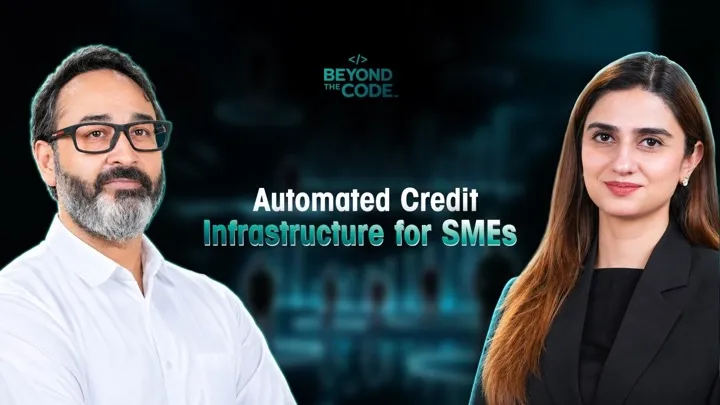
A conversation with Syeda Mahrukh Raza, Founder & CEO, Lean Outset, on why so much SME income never becomes a credit file, what her product actually does for banks, and why she is still in the game as a solo founder.
I sat down with Syeda Mahrukh Raza, Founder and CEO of Lean Outset, expecting a tour of a fintech product. What I got was a clearer picture of why so many small businesses never get a facility, even when the money is real and already moving through a bank account.
She came to that problem the long way. Computer science at GCU, an internship at the Microsoft Innovation Center in Plan 9, around two years in a small IT services firm, then Systems Limited, then a layoff at Unifonic while she was still on probation. It was Systems that pushed her to start: they could be her first client if she trained a business analyst and outsourced the work back. She spent about eight months at Stewart Title first, to get emergency funds in place. KT Bank, which she said is now called Buraq Bank, later became that first client as a three-month adviser, after she turned down a full-time role that would have meant moving to Karachi. Sitting with bankers who had 30 years of experience is where the SME idea stopped being abstract.
Banks already know the gap
The people she started talking to were unusually blunt. One bank said the work had not been done here yet. Another said the State Bank pushes them hard on it. Some had not really worked SMEs, she was told, in the last 20 years.
She went and read the regulations. The State Bank, as she described it, has four priority segments: digital, SME, housing and agri. She had already worked in agri. Housing was even less developed. SME looked, at first, like the more workable gap. Later she understood why it had stayed untapped. She picked it up anyway, and built a digital product for financing rather than trying to sell the same idea as consulting.
An aggregator, not another branch
Zaal, the product, sits between banks and SMEs. It helps small businesses get access to financing, builds their capacity and financial literacy, and helps them meet the bank’s requirements. A lot of businesses, she said, are simply not prepared to qualify.
I asked whether this was an onboarding tool, a compliance guide, or something more interactive. Her answer was less about features than about what happens when an SME walks into a branch. If you are lucky, or you arrive with a reference, they may take your data. Then you often hear nothing. Premium clients get the doors opened. The problems sit with the SMEs. What Zaal does, in her telling, is digitally onboard and evaluate the business, then tell the owner the things the bank often will not: what has cleared, and what is hurting their eligibility.
The name has a story. The company is Lean Outset. The product is Zaal, from the Persian epic Shahnameh: a child born with white hair, abandoned, then raised and guided by the Simurgh. She connected that to her own position, a young woman taking a new product to major banks. Even a product built for a big mission, she said, is still a baby being sold to giants.
The income the bank cannot see
This is where the conversation got practical. I put a common pattern to her: a private limited company that only shows taxable, structured income, with everything else landing in a personal account. How do you combine those two pictures for a bank?
You don’t, not really, unless the owner makes the informal part visible. If you want more financing, she said, you have to give visibility across your revenue streams. Legal income that never hits the business account, or arrives without invoices because buyers do not want a GST hassle, leaves the bank unable to judge repayment capacity. Payment into the business account can be treated as revenue. Payment into a personal account is, from the bank’s point of view, a personal transaction. If someone is ready to migrate that activity, she would want at least six months or a year of statements. More is better. She does not do consumer or corporate financing, and she defines an SME as a business generating under Rs 2 billion. Micro and nano lending, she was clear, is a different doctor.
They buy a service, not a platform
I asked whether this was a product, a service, or both. Both, in sequence. When they are educating a customer and taking a case, it is advisory work. The platform is how that service is delivered. The go-to-market is a service pitch. Then they tell the customer they will have to use the product to get the service. She was careful on pricing: they are early, and not charging too much at the beginning. The mechanism, she said, is a revenue share. I did not press for the number.
The same idea shows up in Lean Her Way, a project she described as backed by the Asian Development Bank and managed by the State Bank of Pakistan, under the Women Inclusive Financing Program Challenge Fund. She said they were one of the top five recipients, and the only fintech in that group, with HBL Microfinance Bank as the first financial-institution partner. The work is capacity as well as credit: helping women-led businesses document income and become eligible for financing.
Stay in the game and wait
The setbacks she named were about trust. Pitch a large organisation, she said, and sometimes they get so motivated they start building the idea themselves. She once saw job ads for a business analyst and a product manager the day after a conversation, and stopped talking.
What keeps her going is more prosaic than a speech. She called it a bounce-back ability: a dip, then a useful email, then the sense that people are taking it seriously. Job offers keep arriving. A bank CEO told her to stay in the game and wait. It will take time, he said, but it will happen.
She has no co-founder. Some VCs reject her for that. Some businesspeople tell her she does not need one if she can hire. She is open to it, and also treated it like a marriage: the wrong partner is worse than waiting. The real risk, which she did not dodge, is the obvious one. If something happens to her, there is no one else to own the company.
Her vision is not a quick alignment with one bank and a sale. She does not see Lean Outset becoming a bank. She sees it as a pillar of banking, the kind of piece that would be missed if it were not there, the way a bank would feel the absence of cards. She wants to grow it as far as she can, stay a founder, and let someone else lead day-to-day execution if they can do it well.
I came in to understand a product. I left thinking the constraint in SME finance is more basic than that. The income is often already there. The bank can only lend what it can see.
Thanks to Syeda Mahrukh Raza for the conversation. Watch the full episode on YouTube.
In this episode
- 00:00 Introduction
- 00:52 Education and early internships
- 02:00 First job in IT services
- 03:11 Systems Limited years
- 05:36 Why she deferred her Master's
- 07:00 Deloitte rejection
- 08:19 Layoffs and a push to start up
- 09:45 Side hustle and startup scene
- 11:00 Advisory work with KT Bank
- 13:28 How the SME idea began
- 15:27 What the product does
- 15:55 The story behind Zaal
- 17:10 Advisors and mentors
- 18:28 How the platform works
- 19:54 Handling undocumented income
- 23:30 Defining an SME and the pitch
- 25:42 Lean Her Way
- 27:51 Setbacks and IP concerns
- 30:17 What keeps her going
- 33:00 Why no co-founder
- 36:41 Vision and exit strategy
- 40:21 Staying flexible
- 41:04 Life beyond business
- 42:21 Alternate career paths
- 43:41 A typical day and burnout
- 47:13 Message for women founders
- 49:57 The role of men
- 51:49 Why women leave work